AI · EXPERIMENT
Embedding Studio
A local workbench for testing how Qwen3-Embedding-4B places words and phrases in a 2,560-dimensional space.
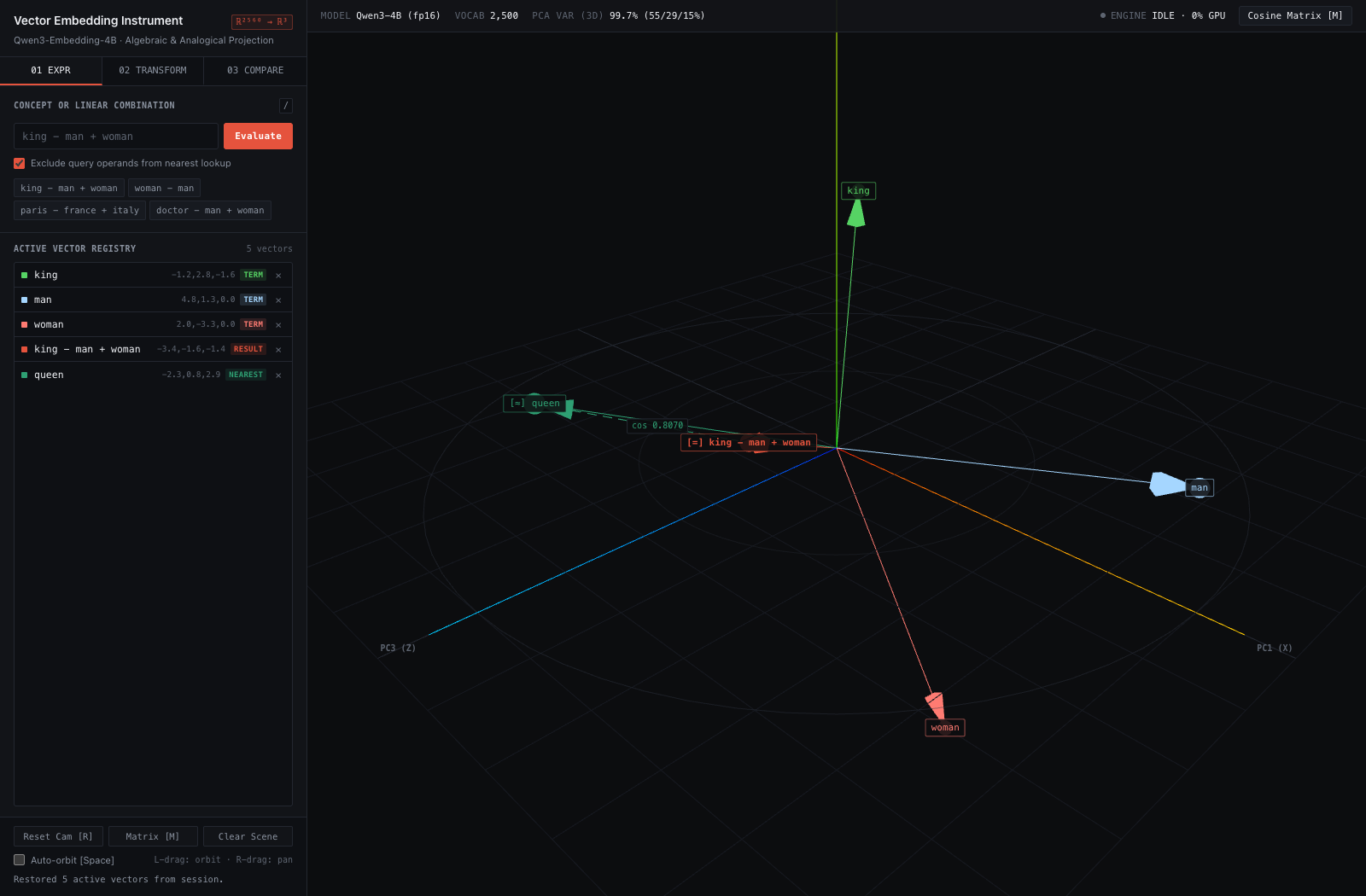
I wanted to see what an embedding was doing without having to stare at a vector of numbers. This workbench runs words and phrases through Qwen3-Embedding-4B, lets me combine their vectors, then shows which entries in the vocabulary land nearby.
Try an expression
Type an expression such as king - man + woman and the tool embeds each term, combines the vectors, then searches for the closest words in its vocabulary. The Transform tab gives the same idea a clearer shape: choose a base, then move it along the difference between a source and a target. The instrument also compares two phrases directly and can show their cosine similarity.
Compare in the full space
The model represents each phrase with 2,560 values. Similarity and nearest-word search use those full vectors. The 3D scene is a PCA projection, which makes the relationships easier to inspect. It cannot preserve every distance from the original space. The interface shows how much variance each axis explains.
A vocabulary that grows with the session
The tool starts with a curated index of 2,500 words and adds new inputs as they are used. Nearest neighbors come from that index. The interface plots the terms and results together and can open a cosine-similarity matrix for the active set. The renderer sleeps while the scene is still.
Run it locally
Embedding Studio is a local Python app with a browser interface. It loads Qwen3-Embedding-4B on Apple Silicon, CUDA or CPU. The model weights take roughly 7.5 GB on the first run; later runs can use the local cache. The source and setup instructions are on GitHub.
Built with Python, Qwen3 Embeddings, NumPy, PCA.